How To Get Repo Off Credit Report?
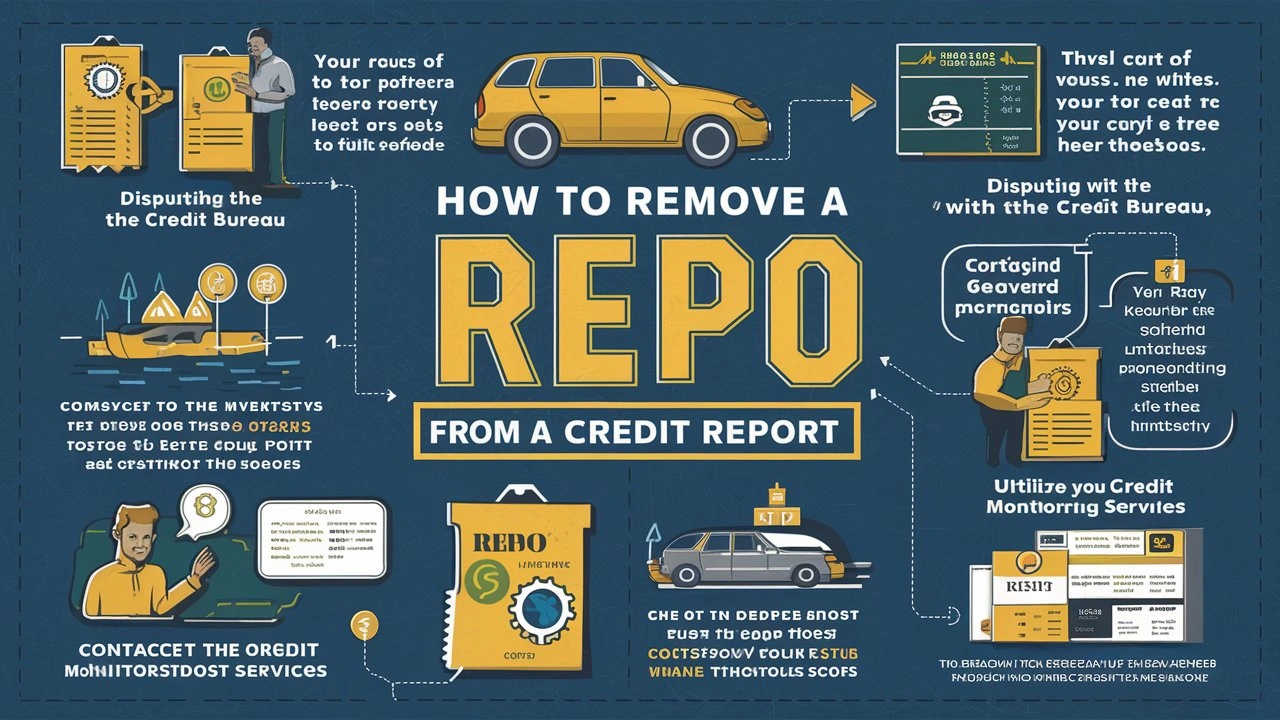
Facing a vehicle repossession on your credit report can feel like a major setback, but understanding how to address it is the first step toward financial recovery. This guide provides a clear roadmap to navigate the process of getting a repo off your credit report, offering actionable strategies and expert insights for 2025.
Understanding Repossession and Its Credit Impact
A vehicle repossession occurs when a borrower fails to make their auto loan payments. The lender then has the legal right to repossess the vehicle to recoup their losses. This event is a significant negative mark on your credit report, impacting your credit score considerably and making it harder to obtain future credit, rent an apartment, or even secure certain jobs.
In 2025, the credit scoring models, such as FICO and VantageScore, heavily penalize a repossession. It signals to lenders that you have a history of defaulting on secured debt. The severity of the impact depends on several factors, including your credit score before the repossession, the presence of other negative items on your report, and how long the repossession remains on your report. Typically, a repossession can lower your credit score by 50 to 100 points or more. This negative information can remain on your credit report for up to seven years from the date of the original delinquency, even if the debt is eventually paid off.
Understanding the mechanics of repossession is crucial. It's not just about losing the car; it's about the long-term financial repercussions. The lender may sell the vehicle at an auction, and if the sale price doesn't cover the outstanding loan balance plus repossession costs, you may still owe a deficiency balance. This deficiency can also be reported to credit bureaus, further damaging your credit.
The Legal Process of Repossession
While the specifics can vary by state, lenders generally must follow certain legal procedures. They typically must provide you with notice before repossessing the vehicle, though this notice period can be short. They cannot breach the peace during repossession, meaning they cannot use force or enter your locked garage. Once repossessed, the vehicle is often sold at a public or private sale. You usually have the right to redeem the vehicle before the sale by paying the full outstanding loan balance and any associated fees. After the sale, you should receive a notice detailing the sale and any remaining balance owed.
The Long-Term Financial Fallout
Beyond the immediate credit score drop, a repossession can lead to higher interest rates on future loans, increased insurance premiums, and difficulty obtaining credit for essential purchases like a home or another vehicle. Lenders view a repossession as a high-risk indicator. The emotional toll can also be significant, adding stress to an already challenging financial situation. For many, the primary goal becomes not just removing the repo from their credit report but rebuilding their financial life and creditworthiness.
Checking Your Credit Report for Accuracy
The first and most critical step in addressing a repossession on your credit report is to obtain copies of your credit reports from all three major credit bureaus: Equifax, Experian, and TransUnion. You are entitled to a free credit report from each bureau annually through AnnualCreditReport.com. It's vital to check all three because lenders may report information to different bureaus, and inaccuracies can exist on one or more reports.
Once you have your reports, meticulously review the section detailing your credit accounts. Look for the repossession entry. Pay close attention to the following details:
- Date of the repossession: Ensure this date is accurate.
- Account status: Verify that the account is accurately reflected as repossessed.
- Outstanding balance: Check if the reported balance is correct, especially if the vehicle was sold and a deficiency balance remains.
- Lender information: Confirm the name and contact details of the lender are correct.
- Personal information: Ensure your name, address, and Social Security number are accurate.
Why Accuracy Matters
Inaccurate information on your credit report can unfairly harm your credit score. For instance, if the repossession date is wrong, it might remain on your report longer than legally permissible. If the outstanding balance is inflated, it can create a false impression of your financial obligations. Identifying these errors is the foundation for disputing them and potentially getting the entry removed or corrected.
How to Obtain Your Credit Reports
As mentioned, AnnualCreditReport.com is the official, government-mandated source for free credit reports. You can request your reports online, by phone, or by mail. It's recommended to stagger your requests throughout the year, obtaining one report every four months from a different bureau. This allows for continuous monitoring of your credit information.
Key Information to Look For on Your Report:
| Information to Verify | What to Check For |
|---|---|
| Account Name & Lender | Correct lender name, correct account number (often partially masked). |
| Date Opened | Accurate start date of the loan. |
| Date of Last Activity | Crucial for determining how long negative items stay. |
| Status | Should accurately reflect "repossessed," "charged off," or "paid charge-off" if applicable. |
| Balance | Verify the outstanding amount owed, especially after sale. |
| Date of Delinquency | The first missed payment date that led to the repossession. |
| Date of Charge-off | If the lender wrote off the debt. |
| Date of Repossession | The actual date the vehicle was taken back. |
Validating the Debt: Your First Line of Defense
Before you can effectively dispute or negotiate, it's essential to validate the debt. This means formally requesting proof from the creditor or debt collector that they legally own the debt and that the amount they claim you owe is accurate. This process is often referred to as a "debt validation letter."
If a debt collector, rather than the original lender, is trying to collect a deficiency balance, they are legally required to provide you with validation upon request within 30 days of their initial contact. Even if it's the original lender, requesting validation can still be a powerful tool. It forces them to provide documentation supporting their claim.
What to Include in a Debt Validation Letter
Your debt validation letter should be sent via certified mail with a return receipt requested. This provides proof that the creditor received your request. In the letter, clearly state that you are requesting validation of the debt and that you dispute its accuracy until proven otherwise. Specifically ask for:
- Proof that they are licensed to collect debts in your state.
- The original signed contract or agreement.
- A detailed accounting of the debt, including all charges, payments, and interest applied.
- Proof of the vehicle's sale, including the date, location, and the amount it sold for.
- Calculation of the deficiency balance, if applicable.
When to Send the Letter
The sooner, the better, especially if a debt collector is involved. However, even if the repossession has been on your report for some time, requesting validation can still be beneficial. If the creditor cannot provide sufficient proof, they may be legally obligated to stop collection efforts and potentially remove the negative information from your credit report. This is particularly effective if the debt has been sold to multiple collectors over the years, increasing the chances of lost documentation.
What Happens After Sending the Letter?
If the creditor provides satisfactory validation, you'll have the necessary documentation to understand the debt and proceed with negotiation or dispute. If they fail to provide validation, or if the documentation is insufficient, you have strong grounds to dispute the debt with the credit bureaus and potentially with the creditor directly. This can be a crucial step in getting inaccurate or unproven debts removed.
Negotiating with the Creditor
Negotiation is a key strategy for dealing with the aftermath of a repossession, especially if there's a deficiency balance. Even if you can't directly remove the repossession from your report through negotiation, you might be able to mitigate its financial impact and improve your chances of a more favorable outcome.
Negotiating a Deficiency Balance
After the vehicle is sold, if the sale price is less than the amount owed, you'll likely face a deficiency balance. Lenders are often willing to negotiate this amount. They may prefer to settle for a lesser amount than to pursue legal action, which can be costly and time-consuming. When negotiating, be prepared to:
- Know your rights: Understand state laws regarding deficiency balances and repossession sales.
- Be realistic: Have a clear understanding of what you can afford to pay.
- Offer a lump sum: Often, creditors will offer a significant discount if you can pay the negotiated amount in a single lump sum.
- Propose a payment plan: If a lump sum isn't feasible, propose a reasonable monthly payment plan.
Negotiating a "Pay for Delete" Agreement
This is a more advanced negotiation tactic. A "pay for delete" agreement is when you offer to pay a portion or all of the debt in exchange for the creditor agreeing to remove the entire tradeline (the repossession record) from your credit report. This is highly desirable because it directly addresses the negative mark on your credit. However, it's important to note that:
- Not all creditors agree: Many lenders and debt collectors are hesitant or outright refuse to agree to "pay for delete" because it's not a standard practice and can set a precedent.
- Get it in writing: If a creditor agrees to a "pay for delete," ensure this agreement is in writing and signed by both parties before you make any payment. Verbal agreements are difficult to enforce.
- Timing is crucial: It's often more effective to negotiate "pay for delete" before the debt is sold to a third-party debt collector, as original lenders may have more flexibility.
Sample Negotiation Script (Deficiency Balance)
“Hello [Creditor Name/Representative Name], my name is [Your Name]. I am calling regarding the deficiency balance on my auto loan account, ending in [last four digits of account number]. I understand that after the repossession and sale of the vehicle, there is a balance of [Original Deficiency Amount] remaining. I am currently facing financial difficulties but am committed to resolving this debt. I would like to offer a settlement of [Your Offer Amount] to close this account. I am able to pay this amount as a lump sum within [Number] days. Would you be willing to accept this settlement?”
If they counter, be prepared to negotiate. If they don't agree to a lump sum, you can pivot: “If a lump sum settlement isn't possible, I could afford to pay [Monthly Payment Amount] per month for [Number] months, totaling [Total Payment Amount]. Would this be acceptable?”
Disputing Errors with the Credit Bureaus
If you've identified inaccuracies on your credit report related to the repossession, or if the creditor fails to validate the debt, you have the right to dispute these items with the credit bureaus. The Fair Credit Reporting Act (FCRA) mandates that credit bureaus investigate disputes within a reasonable time, typically 30 days.
How to File a Dispute
You can file a dispute online, by mail, or by phone with each credit bureau (Equifax, Experian, TransUnion). Online is often the fastest method. When filing your dispute, be specific and provide as much evidence as possible.
- Online: Visit the dispute section of each credit bureau's website.
- Mail: Send a written dispute letter to the credit bureau's dispute department. Use certified mail with return receipt requested.
- Phone: Some bureaus allow disputes over the phone, but a written record is always best.
What to Include in Your Dispute Letter
Your dispute letter should clearly state:
- Your personal information (name, address, Social Security number).
- The account number of the item you are disputing.
- The specific reason for the dispute (e.g., incorrect date, inaccurate balance, not your account).
- Copies of any supporting documentation (e.g., debt validation letter, payment records, communication with the creditor).
- A clear request for the item to be removed or corrected.
The Investigation Process
Once you file a dispute, the credit bureau will contact the furnisher of the information (the creditor or debt collector) to verify the accuracy of the disputed item. The furnisher has a legal obligation to respond to the credit bureau's inquiry and provide substantiation for the information. If the furnisher cannot verify the information, or if they fail to respond, the credit bureau must remove the disputed item from your report.
What if the Dispute is Denied?
If your dispute is denied, it doesn't mean you're out of options. Review the credit bureau's response carefully. They may have found the information to be accurate based on the evidence provided by the furnisher. You can:
- Gather more evidence: If you have additional proof, you can resubmit your dispute with the new information.
- Contact the furnisher directly: Try to resolve the issue with the creditor or debt collector yourself.
- Consider legal action: If you believe the information is intentionally inaccurate or the credit bureaus or furnisher are not complying with FCRA, you may need to consult an attorney.
Settlement Agreements and Their Impact
Settling a debt, especially a deficiency balance after a repossession, can be a strategic move. When you settle a debt, you pay less than the full amount owed, and in return, the creditor agrees to consider the debt satisfied. This can be a good option if you cannot afford to pay the full balance and want to avoid further collection actions or lawsuits.
How Settlements Affect Your Credit Report
When you settle a debt, the account will typically be updated on your credit report to reflect "settled for less than full balance" or a similar notation. While this is still a negative mark, it's generally viewed more favorably by future lenders than an unpaid, outstanding debt or a charged-off account. It shows that you took responsibility and resolved the obligation, even if at a reduced amount.
Important Considerations for Settlements:
- Get it in writing: Always obtain a written settlement agreement before making any payment. This document should clearly state the agreed-upon settlement amount, confirm that this amount satisfies the entire debt, and specify that the creditor will report the account as settled.
- Tax implications: If a significant portion of the debt is forgiven through a settlement, the forgiven amount may be considered taxable income by the IRS. You might receive a Form 1099-C (Cancellation of Debt) from the creditor. Consult a tax professional to understand any potential tax liabilities.
- Impact on credit score: While settling is better than not paying, the notation of "settled for less than full balance" will still negatively impact your credit score. However, the negative impact is usually less severe than an unpaid charge-off. The repossession itself will likely remain on your report for its full duration unless you successfully dispute it or negotiate a "pay for delete."
Settling with Original Lenders vs. Debt Collectors
Negotiating a settlement with the original lender might be slightly easier than with a third-party debt collector. Original lenders may have more flexibility and be more willing to work with you to avoid the costs of legal action. Debt collectors, especially those who purchased the debt for pennies on the dollar, are often focused on maximizing their return and may be more aggressive in their collection tactics. However, they also might be more open to accepting a lower settlement amount if they believe it's the best they can get.
Example of a Settlement Agreement Clause
“This agreement serves as full and final satisfaction of the debt owed on account number [Account Number]. Upon receipt of the agreed settlement amount of $[Settlement Amount] by [Date], [Creditor Name] agrees to report this account as ‘settled for less than full balance’ to all credit bureaus and will not pursue any further collection actions against [Debtor Name] for this debt.”
The Seven-Year Rule: How Long Does it Stay?
A common question regarding negative credit information, including repossessions, is how long it remains on your credit report. The general rule under the FCRA is that most negative information, such as late payments, charge-offs, and repossessions, can remain on your credit report for up to seven years from the date of the original delinquency that led to the negative status.
Understanding the Seven-Year Clock
For a repossession, the seven-year clock typically starts ticking from the date of the first missed payment that ultimately led to the vehicle being repossessed. It's not necessarily the date the vehicle was physically taken back. This is a critical distinction. If the repossession was a result of a charge-off, the seven-year period usually begins from the date of the charge-off.
Key points regarding the seven-year rule:
- Inaccurate Reporting: If a repossession or any other negative item remains on your report beyond seven years, it is a violation of the FCRA, and you should dispute it immediately.
- Bankruptcy Exception: If the debt associated with the repossession was included in a bankruptcy, it can remain on your credit report for up to seven years from the date of the bankruptcy filing, or up to ten years for Chapter 7 bankruptcies.
- No Removal Before Seven Years (Generally): While you can dispute errors and potentially get an inaccurate entry removed, a legitimate, accurately reported repossession generally cannot be removed from your credit report before the seven-year period expires, unless specific circumstances apply (like successful negotiation for "pay for delete" or a successful dispute of inaccuracies).
What Happens After Seven Years?
Once the seven-year period has passed, the credit bureaus are legally required to remove the repossession entry from your credit report. This is a significant positive step for your creditworthiness. However, it's important to remember that the actual debt might still be legally collectible by the creditor for a longer period, depending on your state's statute of limitations for debt collection. But for credit reporting purposes, it will disappear.
Strategies to Mitigate Impact During the Seven Years
While you wait for the repossession to age off your report, focus on building positive credit history:
- Pay all other bills on time: This is the most crucial factor in improving your credit score.
- Keep credit utilization low: If you have credit cards, try to keep the balances below 30% of your credit limit.
- Avoid opening too much new credit: Multiple hard inquiries can temporarily lower your score.
- Consider secured credit cards: These can help rebuild credit after a repossession.
Preventing Future Repossession
Learning from past financial mistakes is key to building a stronger financial future. Preventing another repossession involves proactive financial management and responsible borrowing habits.
Budgeting and Financial Planning
The foundation of preventing repossession is a solid budget. Track your income and expenses meticulously. Identify areas where you can cut back to free up funds for loan payments. Create an emergency fund to cover unexpected expenses, which can prevent you from falling behind on payments.
Communicating with Your Lender
If you anticipate difficulty making a payment, do not wait until you've missed it. Contact your lender immediately. Explain your situation and ask about potential options, such as:
- Payment deferral: Temporarily pausing payments.
- Loan modification: Changing the terms of your loan, such as extending the term to lower monthly payments.
- Hardship programs: Lenders may have specific programs for borrowers facing financial difficulties.
Lenders are often more willing to work with borrowers who communicate proactively. Ignoring the problem only makes it worse.
Understanding Loan Terms
Before signing any loan agreement, thoroughly understand all terms and conditions, including interest rates, fees, repayment schedules, and penalties for late payments or default. Ensure the monthly payments fit comfortably within your budget.
Building an Emergency Fund
An emergency fund is crucial. Aim to save at least 3-6 months of living expenses. This fund can help you cover unexpected costs like medical bills, job loss, or major home/car repairs without derailing your loan payments.
Responsible Credit Management
After a repossession, rebuilding responsible credit habits is paramount. This includes:
- Making all payments on time: This is the single most important factor for credit health.
- Keeping credit utilization low: High utilization can signal financial distress.
- Avoiding unnecessary debt: Only borrow what you truly need and can afford to repay.
- Monitoring your credit reports: Regularly check your reports for errors and to track your progress.
When to Seek Professional Help
While many aspects of dealing with a repossession can be handled independently, there are situations where seeking professional assistance is highly recommended. This can provide expert guidance, save you time and stress, and potentially lead to better outcomes.
Credit Counseling Agencies
Non-profit credit counseling agencies can offer invaluable assistance. They can help you:
- Create a budget: Develop a realistic spending plan.
- Negotiate with creditors: Some agencies can negotiate on your behalf for lower interest rates or payment plans.
- Debt management plans (DMPs): Consolidate your debts into a single monthly payment, often with reduced interest rates.
Ensure you choose a reputable agency accredited by the National Foundation for Credit Counseling (NFCC) or the Financial Counseling Association of America (FCAA).
Consumer Protection Attorneys
If you believe the repossession was unlawful, or if the creditor or debt collector is engaging in illegal practices (like harassment, wage garnishment without proper notice, or violating FDCPA regulations), you should consult a consumer protection attorney. They can:
- Review your case: Determine if your rights have been violated.
- Represent you in legal proceedings: Defend you against lawsuits or take legal action against the creditor.
- Negotiate settlements: Potentially secure a more favorable outcome than you could on your own.
Many consumer attorneys offer free initial consultations.
Financial Advisors
For broader financial planning and long-term credit rebuilding strategies, a financial advisor can be beneficial. They can help you create a comprehensive financial plan that accounts for the impact of the repossession and guides you toward achieving your financial goals.
When Professional Help is Most Crucial:
- Unlawful Repossession: If you suspect the repossession violated state or federal laws.
- Harassment or Illegal Collection Tactics: If you are being subjected to abusive or illegal debt collection practices.
- Impending Lawsuit: If the creditor is threatening or has initiated legal action to collect a deficiency balance.
- Complex Financial Situation: If you have multiple debts, significant financial challenges, or are unsure how to proceed.
- Difficulty Negotiating: If you are unable to reach a satisfactory agreement with the creditor or debt collector.
Don't hesitate to seek professional advice. The cost of professional help can often be far less than the long-term damage of unresolved debt or improper handling of a repossession.
Conclusion
Navigating the removal of a repossession from your credit report in 2025 requires a strategic, informed, and persistent approach. While a repossession is a serious negative mark, it is not a permanent financial death sentence. By thoroughly checking your credit reports for inaccuracies, diligently validating the debt, and engaging in skillful negotiation with creditors, you can significantly mitigate its impact. Remember that disputing errors with credit bureaus and understanding the seven-year rule are crucial steps in the process. Furthermore, focusing on preventing future repossessions through sound financial management and responsible credit habits is paramount for long-term financial health. If you find yourself overwhelmed, don't hesitate to leverage the expertise of credit counselors or consumer protection attorneys. Taking proactive steps now can pave the way for a stronger credit future.